
We are grateful to share the story of John Elliott, Mapperley’s most successful rugby exponent. A man whose dedication to the sport from the 1960s, took him through the professional era and on to roles with the England management, including the 1991 and 1995 Rugby World Cup tournaments.
High Pavement – Old Paviors RFC – Paviors RFC
John Elliot hasn’t always lived in the Mapperley area. Born and brought up in Radford where his father worked at Players tobacco and cigarette manufacturers. He attended Berridge Road School and after passing the Eleven-Plus exam, moved on to High Pavement Grammar School, At the time, High Pavement was on Stanley Road in Forest Fields, and had been since 1895. In 1955, after just one year, he moved, as did the school, to a new site at Bestwood Park.
It was at High Pavement that John developed a lifelong love of rugby, representing the school at all age groups. John played alongside other Paviors like Roger Moakes, John Pallant, Ben Rutt and Butch Stinchcombe. He was soon selected to play for the NLD (Notts, Lincs and Derbyshire) Under 18s.
On leaving school at eighteen, he joined the East Midlands Electricity Board as a student apprentice. He remained with the company until it was privatised in 1995, coincidentally the same year that rugby went professional.
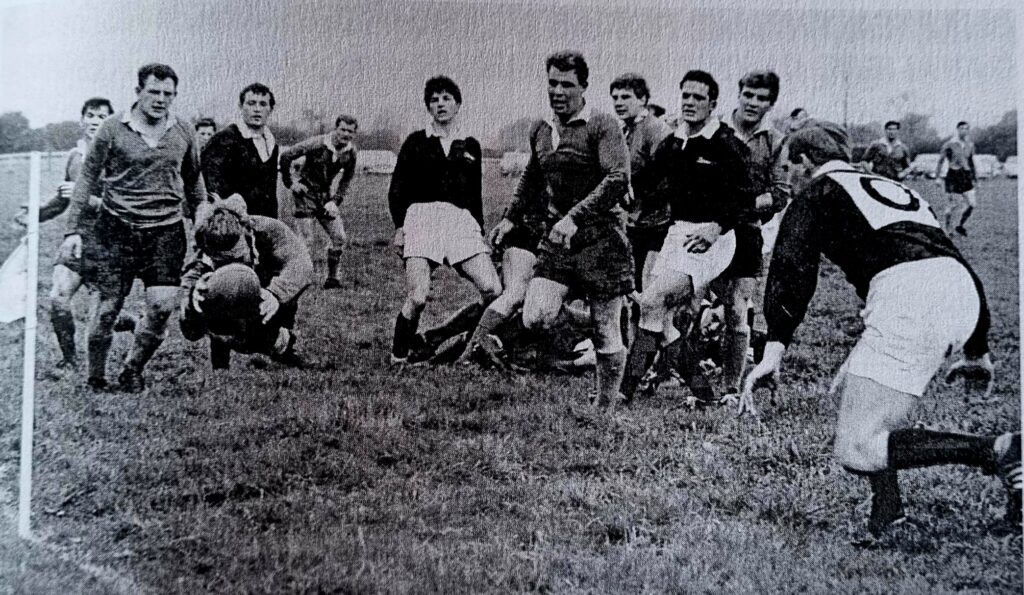
John’s first rugby club was Old Paviors, then a club made up of Old Boys of High Pavement Grammar School.
The Student Apprenticeship Course at East Midlands Electricity Board lasted for five years, this was a combination of studying for a degree in Electrical Engineering at Loughborough University and gaining work experience in all departments of EMEB. Part of this Student Apprenticeship required some industrial experience which included six months with Bruce Peebles Ltd in Edinburgh. This gave him the opportunity of playing for Edinburgh Wanderers, whose home ground was at Murrayfield Stadium, before the internationals began in the new year.
Move To Mapperley
On completing the course, John worked as a Mains Engineer in the Nottingham District. This led to the opportunity of moving to EMEB’s Head Office at Coppice Road, off Mapperley Plains. In the role of Marketing Engineer, he supported the sales staff in the East Midlands Area by improving public awareness of the benefits of electricity in the domestic, commercial and industrial sectors. This included television advertising, and during the making of a television commercial that he spent quite an amount of time working with a certain Brian Clough, an experience John will never forget!
On privatisation in 1995, John was fortunate to be offered early retirement which he gratefully accepted and almost immediately was invited by the RFU to become their National Player Development Manager, a job he then held until he finally retired in 2011.
Three Counties Rugby
Rugby had always played a major role in John’s life and while studying for his degree at Loughborough University he was also able to enjoy the opportunity of playing rugby for the Colleges Team which included mostly students on physical education courses. He was very fortunate to play in teams with many gifted players including Colin McFadyean (capped 11 times by England and a British Lion), Gerald Davies of Cardiff, London Welsh and Wales (capped 46 times for Wales and a British Lion). The coach at Loughborough was John Robbins who went on to become the first coach of the British Lions. Whilst at Loughborough, John also represented British Universities.
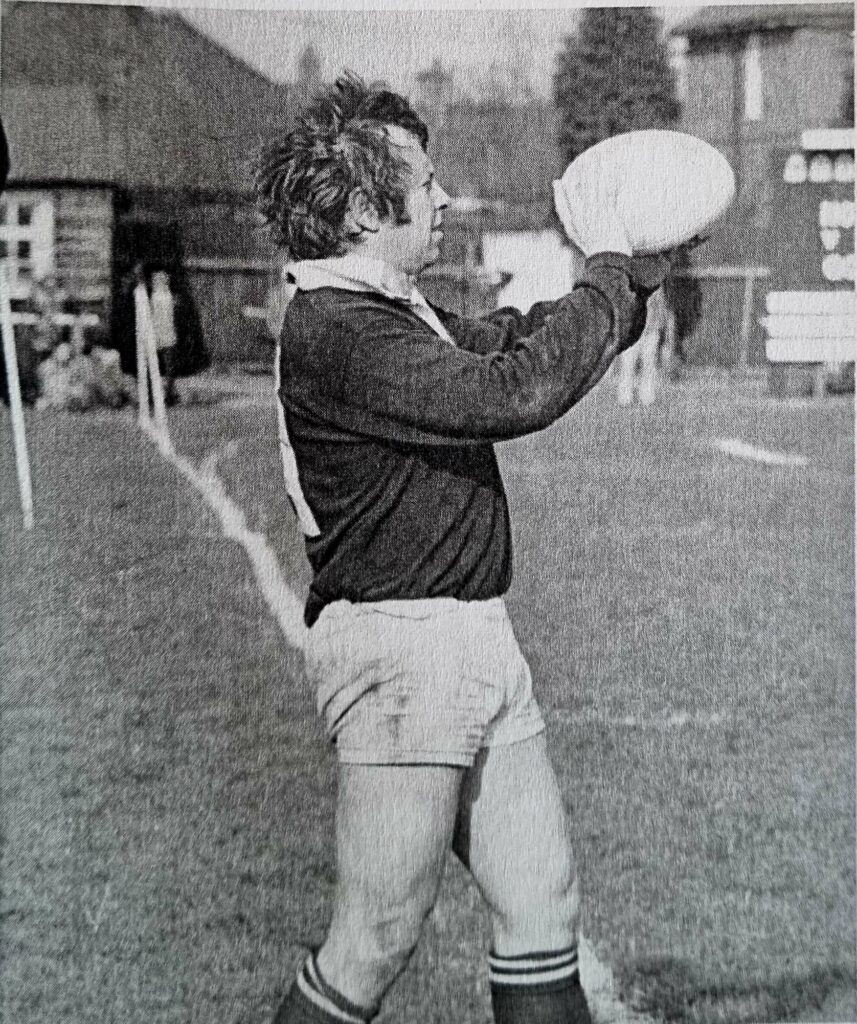
From 1966 -1971 John played for Leicester. He also represented and captained the Notts, Lincs and Derbyshire side regularly. In those days county rugby was an alternative pathway to England honours and the Three Counties played their home games at Newark, the only ground in the area at the time which had floodlights! Representative honours continued John was regularly in the East Midlands Squad and in 1971, the Centenary Year of the Rugby Football Union, John played for the North of England, in a side featuring Fran Cotton, Roger Uttley, Sam Doble and Alan Old, against the Presidents World XV at Gosforth Newcastle. The World XV was captained by the legendary Colin Meads, one of the greatest rugby players in the history of the game.
With the first of his three daughters on the way, John moved clubs and joined Nottingham for the 1972/73 season, his place as hooker for Leicester being filled by Peter Wheeler. At lreland Avenue, Beeston (then home of Nottingham Rugby Club) John played with the likes of John Pearce, Paul Irons, lan Clayton and Dusty Hare. In those days with there being no league set-up, Nottingham played the elite of British rugby local derbies with teams such as
Leicester, Coventry and Northampton being particularly special occasions.
International Call-up
In 1976, John had the honour of being selected as one of the six reserves in the 21-man England International squad. However, tactical substitutions were not allowed and for a reserve to take the field, a player had to be genuinely injured. So, despite sitting on the bench at Twickenham and Paris, all kitted up, a full cap for John was not to be. Later that season he was selected by the Barbarians for their annual Easter Tour of Wales.
When he stopped playing top class rugby (he was replaced at Nottingham by Brian Moore) though still working for EMEB, John became involved in the England management set-up. Initially as Manager of England Under 21s and then from 1991 to 1998 as a selector, and then Assistant Manager of the full England team. He was involved in the Rugby World Cup of 1991, where England were narrowly beaten in the final by Australia, and then again four years later in South Africa. In 1993, he managed the England Under 21s for the first ever tour to Australia with players such as Mike Catt, Will Greenwood, Richard Hill, Austin Healy and Lawrence Dallaglio in the party. In 1995 he became National Player Development Manager before retiring in 2009. For several years, he managed the England Sevens squad, playing in the World Series, this meant a lot of travelling around the world.
Retirement
Since retirement in 2011, John has still watched Loughborough University and remained associated with both Nottingham RFC and Paviors RFC. Looking back at his long and illustrious career, this modest, retiring man has no regrets about not playing in the era of professionalism, reflecting with a sense of rightful pride on the hundreds of friends he has made within the sport of rugby and the joy it has brought to his life.
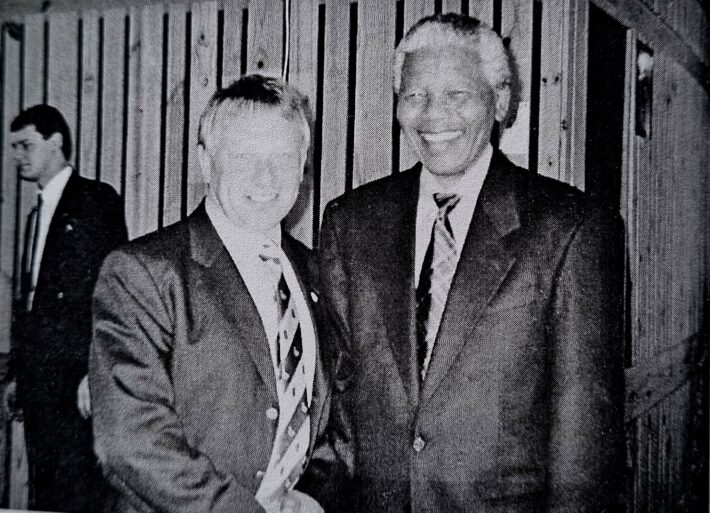
As a testament to his career, as a player of some note and an admired and respected administrator, not only did he play the game with and against the best in his era, John Elliott had the honour of meeting Her Majesty the Queen, Princess Diana and the two young princes, when they were brought to the England training ground. In 1993, two years before the Rugby World Cup in South Africa, John met Nelson Mandela.
John and his wife Helen are now approaching their 50th wedding anniversary, along with their three daughters, Katie, Lisa and Suzie and four grandchildren, Eliot, Toby, Max and Beth.
John regards Gerald Davies as the best player he has ever played with, Will Carling the best captain and Dick Greenwood, the best coach. It says much about the man that after a lifetime of serving the sport he has graced, that, on reflection, he says he has a lot to thank Paviors for!
It is said the only pain in rugby is regret, clearly John Elliott has none.
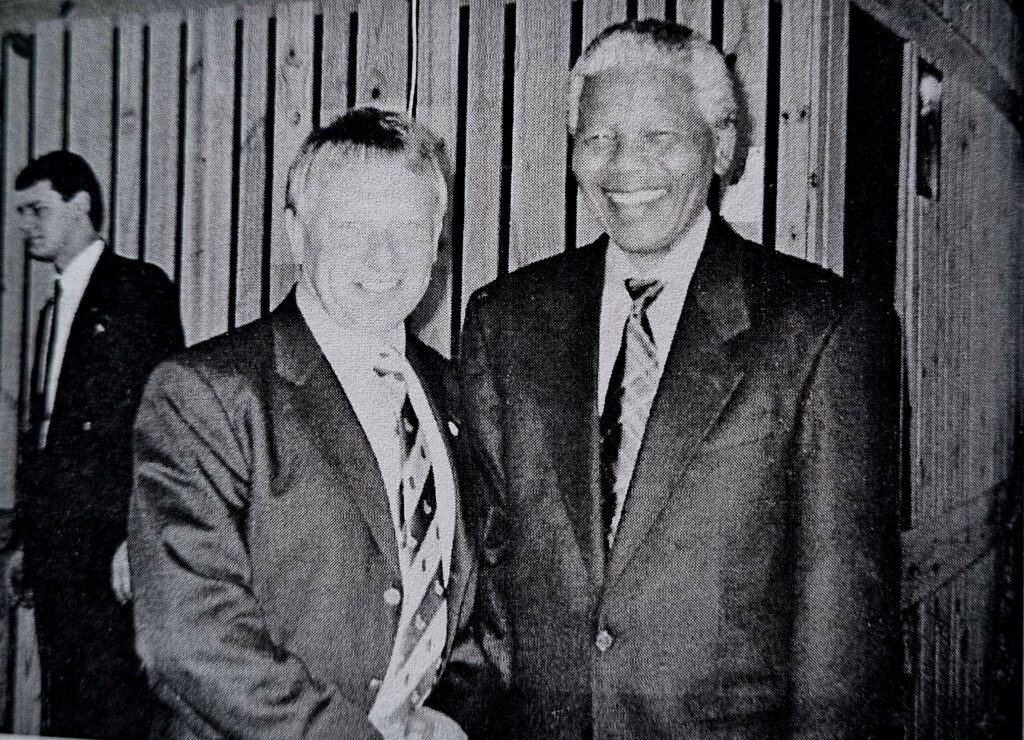
John Elliott meeting Nelson Mandela in 1993, two years before the Rugby World Cup in South Africa.
This article is reproduced (with permission of the author and John’s family) from a book titled Gedling: A Sporting Village. Published in 2017.
A second publication Gedling; A Sporting Village Part 2 features 14 other sporting stories from the area. The author Neil Kendrick can supply copies for £5. Email him at neildragon21@hotmail.com