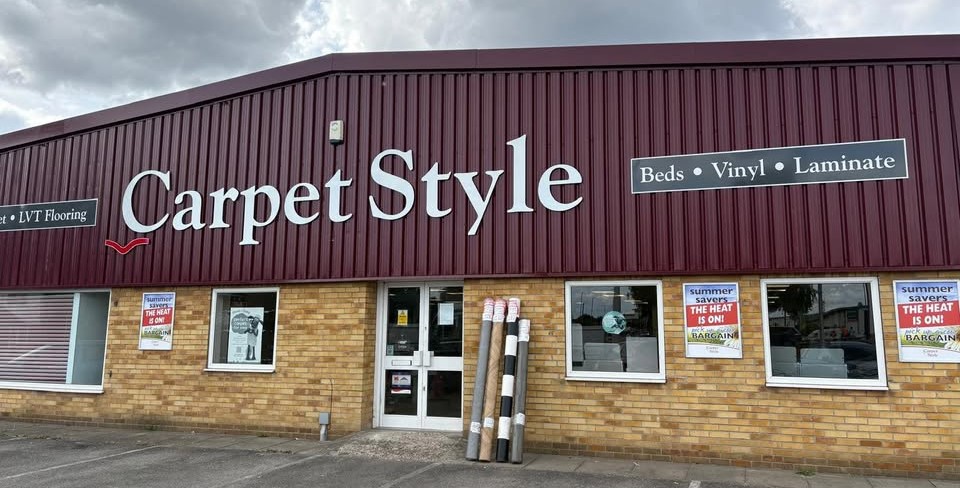
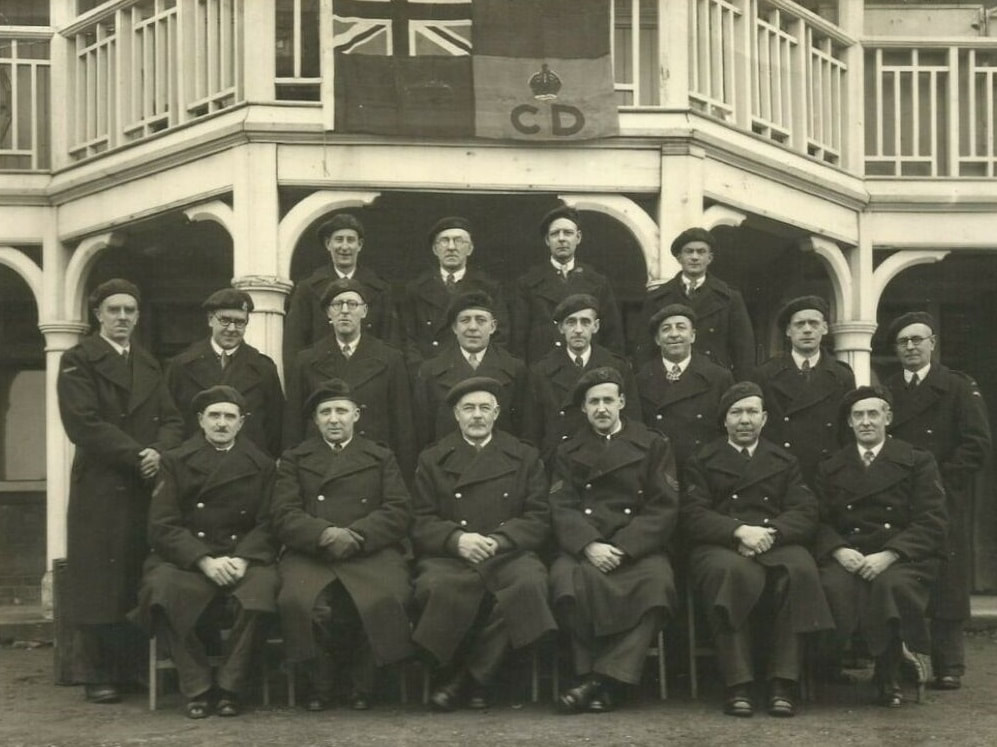
Tucked away in the loft of a 1930s Mapperley house, next to the eve, roofers found a dusty old woollen overcoat. On closer inspection it was found to date back to the second world war, and issued to a Civil Defence volunteer. Could it have been worn by the householder on the night of the Nottingham Blitz in May 1941?
The label and buttons explain the story.
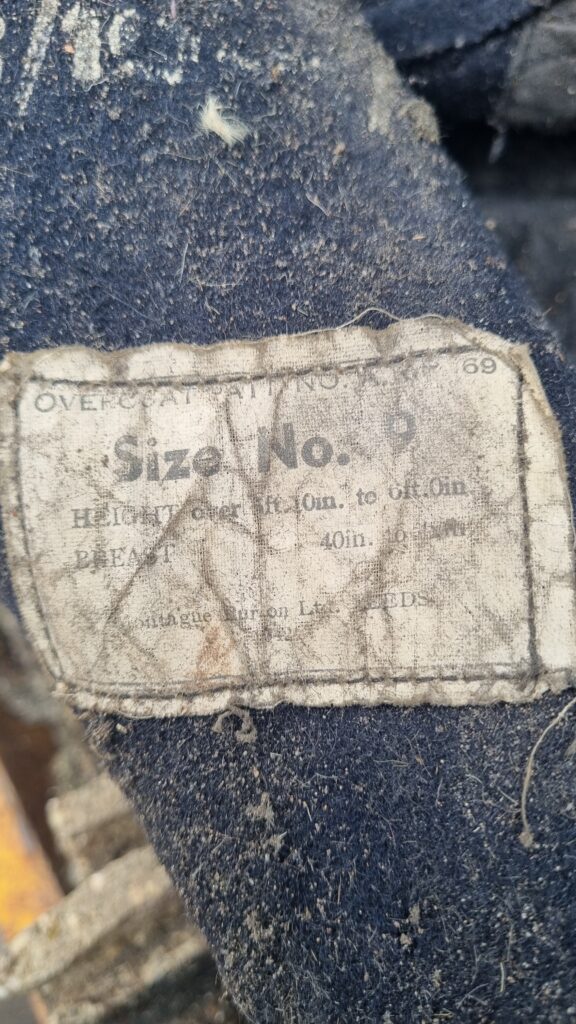
OVERCOAT PATT NO. 69
Size No. 9
HEIGHT over 5ft.10in to 6ft.0in
BREAST 40in. to 4?in.
Montague Burton Ltd. LEEDS
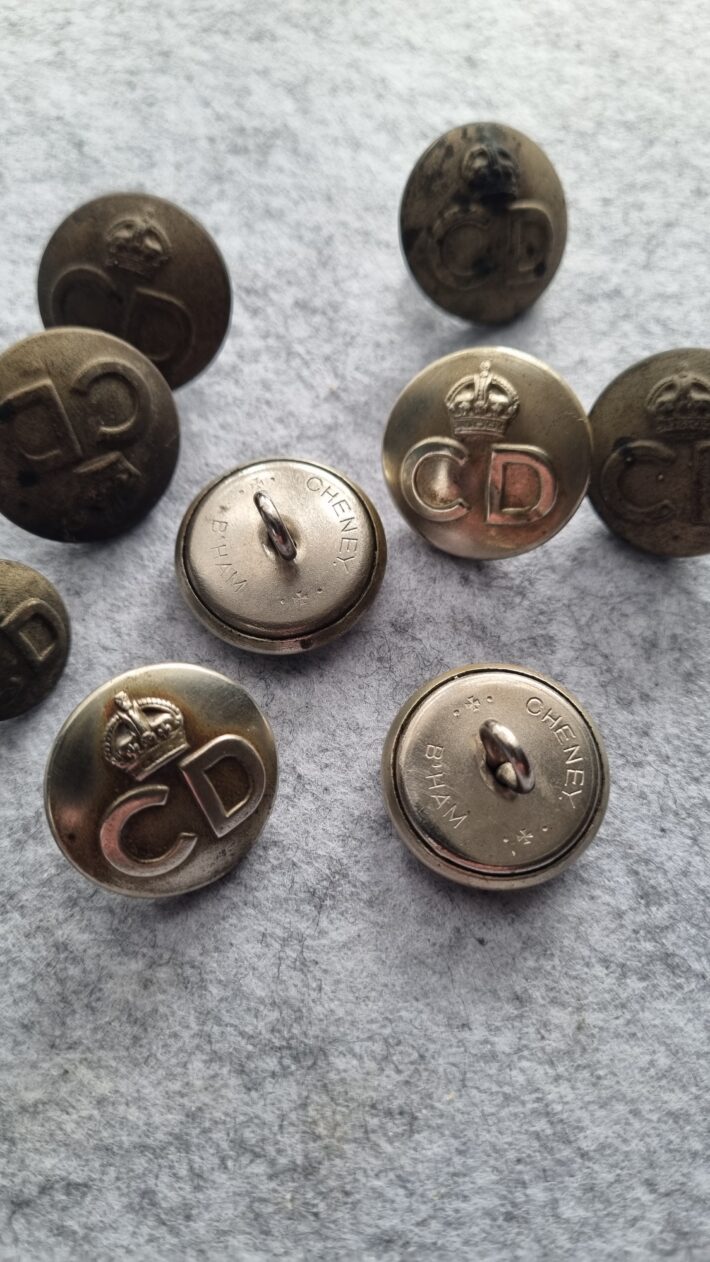
The metal buttons bore the letters
CD beneath the Kings Crown
On the reverse
CHENEY B’HAM
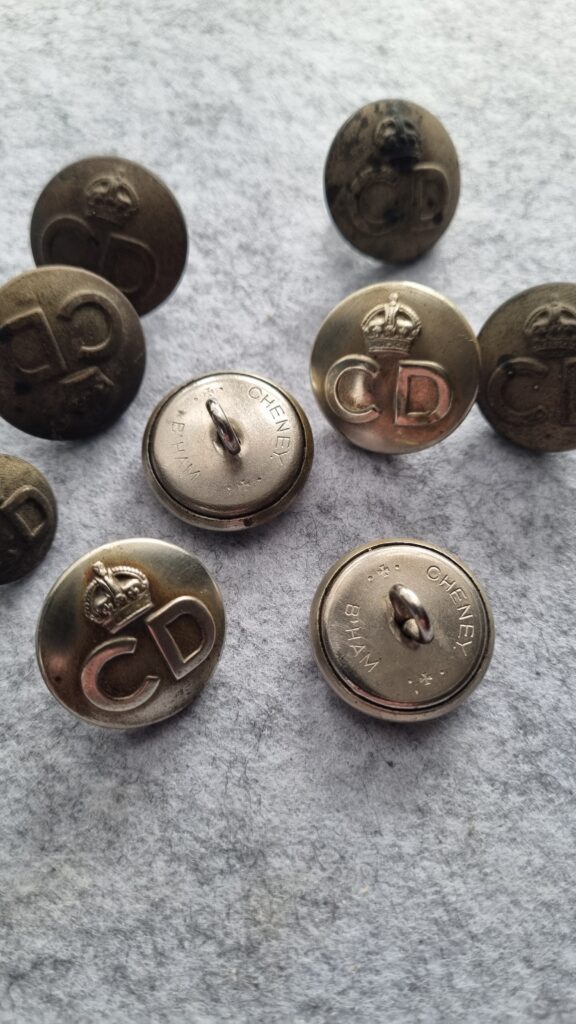
CD stands for Civil Defence. Originally formed in 1935 as the Air Raid Precautions (ARP), the organization renamed its uniform services to Civil Defence in 1941 to unify wardens, rescue squads, ambulance drivers, and messengers. The manufacturer was Cheney Birmingham, based on Factory Road in the Hockley area of Handsworth.
Both Burtons and Cheney no longer exist.
Civil Defence ARP Pattern Number 69
These greatcoats (the term overcoat was also used on labels) were issued to Civil Defence personnel. It was made from thick dark blue or black Melton wool with a weight of 29 oz and 14 different sizes for men and 20 sizes for women were available.
The cut was similar to the army greatcoat with wide lapels and two rows of four buttons to the front (either ARP or CD metal buttons can be found). The coat could be fastened up to the neck. On the inside of the collar were two small buttons; these allow for the throat tab to be attached, this being held on the inside left of the greatcoat also by two buttons.
Epaulettes on the shoulders were fastened with smaller-sized metal CD or ARP buttons. The rear of the greatcoat featured a stitched cross belt on the men’s greatcoat that could not be adjusted; the cross bar was omitted from the female greatcoat. The rear vent had either two exposed metal buttons or two concealed plastic buttons (design was dependent on manufacturer). There were two flapped pockets but no internal pockets.
Information above found in https://www.ww2civildefence.co.uk/greatcoats.html
Montague Burton Leeds
The company’s Hudson Mills factory was located in Burmantofts and at one time was believed to be the largest clothing factory in the world.
Burton’s tailoring firm was founded by the Lithuanian Jewish immigrant, Montague Burton (Meshe David Osinsky) in 1903. Burton emigrated to Britain in 1900 from the province of Kovno. By 1904, he was running a small outfitter’s shop at 20 Holywell Street, Chesterfield. His firm was originally called Burton and Burton. The main production facility from 1914 was Concord Street Mills, Leeds. With the pressure of war work, however, Byron Street Mills was taken on in 1917 as an auxiliary clothing factory. Other facilities were located on Woodhouse Lane, Melbourne Street and Millroyd Street. The demand for ‘demob’ suits enabled Burton to take over the vast Hudson Road Mills in Leeds from the wholesale clothiers Albrecht & Albrecht. At its height, around 10,000 people worked on the site, producing over 30,000 suits a week. Burton, as a factory owner, was conscious of the need to look after his staff and he had a dental surgery, a staff room and canteen. He also installed a sun room for his workers at the factory.
Sir Montague Burton died in 1952, when there were 616 Burton branches. Sir Philip Green’s Arcadia group fell into administration in November 2020 which then led to the closure of Burton’s Hudson Road Mills.
Cheney Birmingham
The letters on the buttons “CD” stand for Civil Defence. Originally formed in 1935 as the Air Raid Precautions (ARP), the organization renamed its uniform services to Civil Defence in 1941 to unify wardens, rescue squads, ambulance drivers, and messengers.The Crown: If there is a crown stamped above the letters “CD”:King’s Crown (with a rounded, domed top): This dates the button precisely from World War II through 1952.
C.W. Cheney & Son Ltd was a prominent Birmingham manufacturer established in 1920 by Charles William Cheney. Based on Factory Road in the Hockley area of Handsworth, the factory was a major local employer that originally specialized in metal case locks, latches, clips, and handles.The factory’s history is characterized by rapid industrial expansion, wartime contributions, and eventual decline.
During World War II in addition to buttons for uniforms, the factory pivoted from making civilian case locks and hardware to producing vital ammunition clips and magazines for Lee-Enfield rifles and Bren guns.