Josephine Louise Angois was a volunteer nurse in the 20th century’s bloodiest war, who lived an extraordinary ‘ordinary’ life. With assistance from the Royal College of Nursing Service Scrapbooks, Mapperley can proudly claim this remarkable woman as our own ‘Florence Nightingale.
Angois’ father, Paul Angois, was born in France in Pierre les Calais, a village associated with the lace industry. As a teenager Paul moved with his family to 13 Nottintone Place, Sneinton. then a village near Nottingham. Rather than pursuing a career in lace, Paul became an engineer. In 1881 he married a French girl, Marthe Guinois, from Orleans. Marthe had been living in Darlington as a French teacher. On 30 May 1884, three years after Paul and Marthe had married, Josephine Louise Angois was born.
A year after Angois’ birth her father set up a small bicycle workshop in Raleigh Street, Nottingham, with a partner, Richard Woodhead, adopting the brand name Raleigh. By 1889 the firm was very successful, with a nominal capital of £20,000. Paul Angois held a secure position as director responsible for design. Sadly, after this upward change in the family fortunes, Angois’ mother died. Angois was only eleven years old. Within a year her father had remarried, an English lady this time, Sarah Ellen Holmes. By the 1901 census Paul was comfortable enough to be listed as a ‘retired cycle manufacturer’.
War On The Horizon
Little is known about Josephine’s life until the Great War loomed and when she answered the call.
Angois did not train as a nurse, but she joined the British Red Cross Voluntary Aid Detachment, Nottingham 40 in 1913. She learnt first aid and home nursing, as well as taking cookery classes. These volunteers became known as VADs and had to pass examinations to become certificated. It is likely that Angois’ training took place at Welbeck Abbey in Sherwood Forest. This was the 6th Duke of Portland and Duchess Winifred’s home. As soon as war broke out they had established an auxiliary Red Cross hospital here. You can see the Duchess conducting a Red Cross Inspection on 31 July 1914 in the scrapbook. On the same page we find a picture of a number of Voluntary Aid Detachments, gathered in the Abbey’s huge Indoor Riding House.
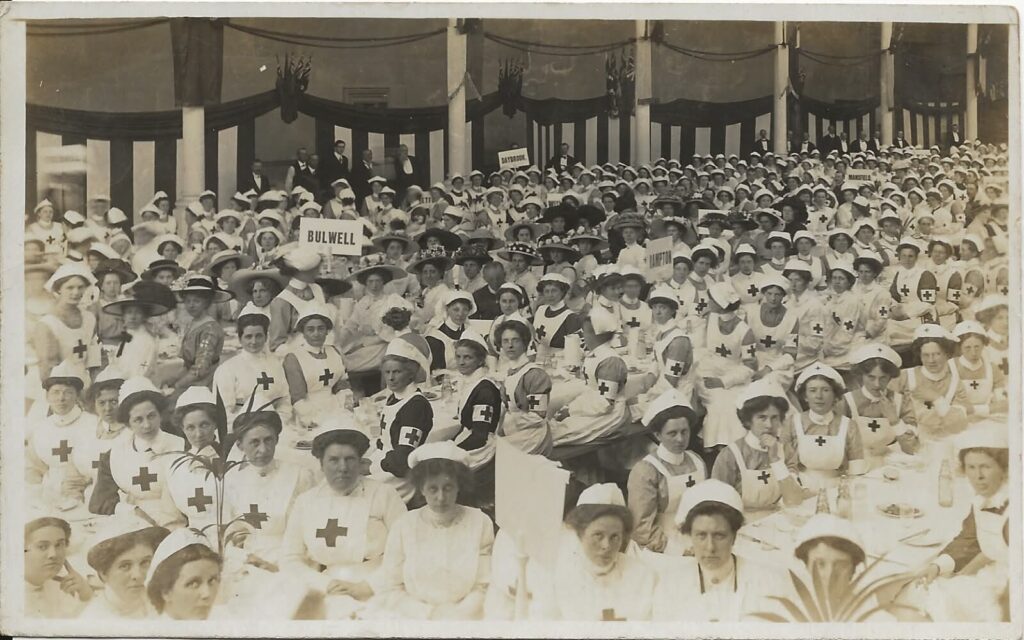
Voluntary Aid Detachments at Welbeck in 1914
VAD Training
Less than a year later, in April 1915, Angois went to number 83, Pall Mall, where she was issued with an Identity Certificate, number 3786, by the British Red Cross. The number is etched on the reverse of her Red Cross badge. She attached this to her scrapbook with a red, white and blue ribbon. One of Angois’ Red Cross cards records the fact she was a J.W.V.A.D. – a Joint War VAD. Most VADs were under the control of the War Office, but others were in the service of the Joint War Committee. This combined the efforts of the British Red Cross and the Order of St. John. These volunteers staffed rapidly expanding hospitals and hostels. Many of them, like Angois, served overseas. They were given some living allowances (Angois received three francs a week for laundry) but no salary for their work. Belonging to the Joint War Committee must have meant something to Angois, as she put part of her brassard (armband) on the cover of her scrapbook. It shows the Order of St. Johns in the top half, and the Red Cross on the bottom. This was kept alongside her Red Cross badge.
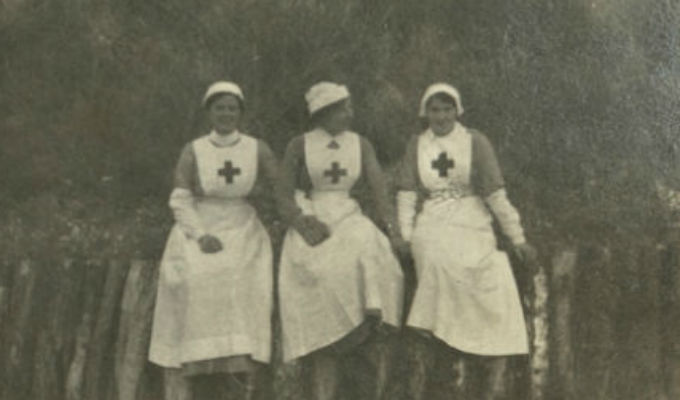
Angois [left] circa 1915
France
During 1915 more nurses were needed to staff the increasing number of hospitals and casualties and the VADs, originally trained for service at home, were now recruited for special service overseas. Angois was one of them. She received a telegram at home – she was called to serve in No. 1 British Red Cross Duchess of Westminster’s Hospital, in Le Touquet-Paris-Plage, France.
Angois’ scrapbook is filled with postcards of the No. 1 British Red Cross Duchess of Westminster’s Hospital, and images of the town, Le Touquet. Le Touquet was very close to Etaples, which was a massive British base with over twenty hospitals.
The No. 1 British Red Cross Hospital was quite a small hospital, with only four wards and 150 beds. Angois kept images of the interior of the hospital. Her pictures show Wards A and B to have been spacious and bright, clean and tidy. The chandeliers were wrapped up in protective cloths with screens on frames around each bed. Although set up initially for all ranks, the hospital soon took in mainly officers, who received a greater degree of privacy.
Nottingham In Mind
Throughout her scrapbook Angois kept a record of news to do with her hometown throughout the war – especially keeping an eye on the exploits of the Sherwood Foresters – a Nottinghamshire regiment. It’s unclear whether she knew someone in the Foresters, or was recording her hometown pride. Perhaps it was a mix of both.
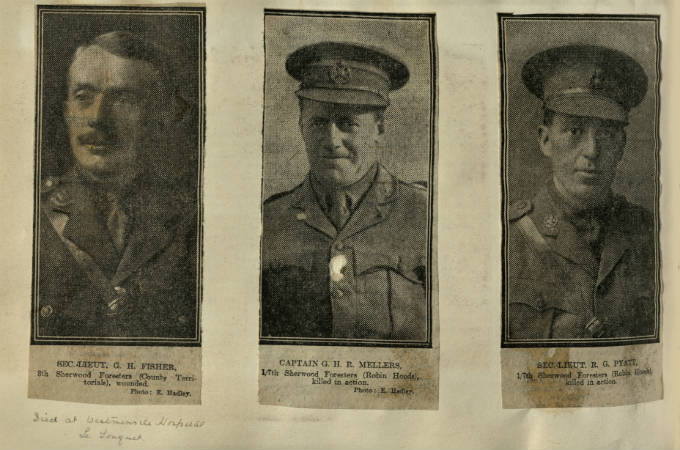
It’s All Right the Sherwoods Are There Newspaper cuttings of Nottingham news.
The Sherwood Foresters who ‘quelled’ a Sinn Fein rebellion
Move to Hampshire Southern General Hospital
Angois started work at the 5th Southern General Hospital, Portsmouth, in February 1917. The hospital was an enormous combination of sites across the Portsmouth and Gosport area, with a total of beds exceeding 1,000 by 1916. Angois worked in a few locations across the complex. She was first sent to the Royal, which was mainly for Officers’ convalescence.
Towards the end of the war she was nursing in Fawcett Road, a requisitioned Girls’ Secondary School. The central hall of the school had been converted into a ward with four rows of beds. A wide gallery ran around the hall, some twenty feet above it, where patients and visitors could walk about or have a smoke. The Matron’s quarters were nearby, so she had close control over the whole hall and over access to the gallery. Many small wards led off it, mostly used as officer’s rooms and operating theatres.
German patients were also being nursed in Fawcett Road although in a separate ward and under guard. It is not clear whether Angois nursed them. Their presence excited local curiosity, but the unnamed nurse assigned to their closely guarded quarters reported ‘they gave no trouble, are very grateful and glad to be where they are’.
Whilst at the 5th General Angois seems to have enjoyed good relationships with her many colleagues. In her scrapbook she collected crammed pages of autographs from staff of all ranks from two of the different areas she nursed in – Headquarters and the Royal Hospital.
After The War – Mapperley
It is hard to tell what impact her experiences during the Great War had on Angois. We have only her scrapbook, filled with pictures and drawings, to look for clues. The many pictures of nursing colleagues and friends enjoying time outdoors, and often with patients, do not speak of misery or hardship. The humour of the British ‘Tommy’ shines through in the cartoons she kept, as does their talent in lovely drawings. Images of patients with their nurses are endearing, and suggest the hospitals she worked in had a warm friendly atmosphere between the patients and staff.
After the war Angois remained in Nottingham for a long time, with her father Paul, at Hillcrest, Malvern Road. He died in 1938. She subsequently moved to Goring-by-Sea and lived with Elizabeth Hunstone – known as Lizzie. Angois and Hunstone purchased a grave together in 1958 at Durrington Cemetery. Hunstone died first, on 16 May 1963 and Angois two years later, on 25 November 1965. Her cause of death coldly reads: Senility. The many photographs Angois placed in her scrapbook are a wonderful legacy, documenting in detail the experience of the VAD and their crucial contribution to the war effort.
Taken from the Royal College of Nursing Service Scrapbook